From Gemini:
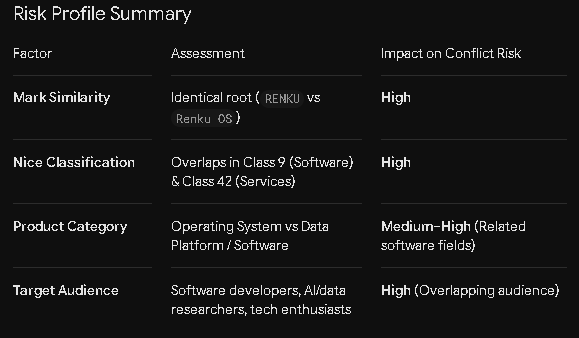
While trademark protection depends on specific legal facts, examining World Intellectual Property Organization (WIPO) International Registration W01444068 and general trademark principles provides clear context on how conflicts are evaluated.
Analysis of WIPO Registration No. W01444068
WIPO International Registration W01444068 ("RENKU") is held by SDSC (Swiss Data Science Center / ETH Zürich / EPFL) and is registered primarily under:
- Nice Class 9: Computer software for data science, reproducible data analysis, workflow management, and collaborative data projects.
- Nice Class 42: Software as a Service (SaaS), cloud computing services, and hosting data science platforms.
The Swiss Data Science Center actively maintains Renku, an open-source platform designed for tracking data provenance, workflow execution, and collaborative reproducible research.
Key Trademark Considerations for "Renku OS"
When evaluating potential trademark risk, courts and trademark offices look at likelihood of confusion, which balances several key factors:
Class and Goods/Services Overlap (Class 9 & Class 42)
While your product is an operating system, both products fall squarely under Nice Class 9 (computer software) and Nice Class 42 (technology services/hosting). In trademark disputes, operating systems and software platform architectures—especially those involving AI or data workflows—are frequently considered "related goods and services." A consumer or developer might reasonably assume that an "AI-driven OS" called Renku OS comes from or integrates directly with the Renku data science platform.
The "OS" Suffix Does Not Eliminate Confusion
Adding generic descriptors like "OS", "Software", "Labs", or "Tech" to an existing mark rarely avoids trademark infringement. Courts generally consider the dominant element of the mark ("RENKU") to be the source-identifying component. Because "OS" merely describes the product type (Operating System), it does not create a strong legal distinction on its own.
Open-Source and Academic Enforcers
Academic and institutional holders of open-source marks (such as ETH Zürich / EPFL for Renku, or the Linux Foundation for Linux) often actively enforce their trademark guidelines to protect brand integrity, prevent user confusion, and ensure the mark isn't diluted or misapplied to unrelated software distributions.
Next Steps to Mitigate Risk
Perform a Broader Prior-Art Search: Beyond the WIPO registration, search local national databases (such as the USPTO if operating in the US) to see if "Renku" is registered independently in specific jurisdictions under Class 9.
Consider Alternative Names: If avoiding trademark disputes and rebrand costs down the road is a priority, selecting a distinct name early in development reduces legal friction.
Formal Legal Review: Consult an IP/trademark attorney to conduct a full clearance search and assess the exact likelihood of confusion prior to launching branding, domains, or public releases.