Remember when programs looked like this?
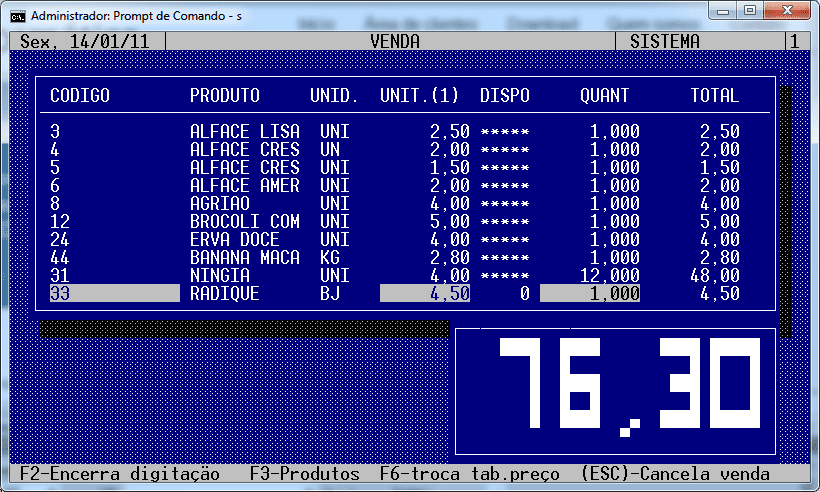
Ah yes, carefully drawn boxes drawn with high-ASCII graphics. Perfect, until your user switched to a different code page. 😦
You might think that those box characters disappeared when we abandoned ASCII for Unicode, replaced by Latin-Extended. But in fact they still exist, just hidden in faraway regions of the Unicode map. And so it should be possible to recreate the glory days of DOS text-mode programming. Possible, but not easy. You can't just assume an 80x25 screen like we did back then.
My new project is to create a series of simple utilities that can be called from any language that can issue a system call to draw boxes, alerts, and menus. I'll probably end up reinventing the wheel and duplicating functionality already in dialog. So be it. That program is unnecessarily weird.
Proof of concept: The first utility is up. In source code only for now: https://codeberg.org/clasqm/boxutils
What does boxmaker do? Glad you asked. It makes boxes. That's it. I told you I was going for simplicity.
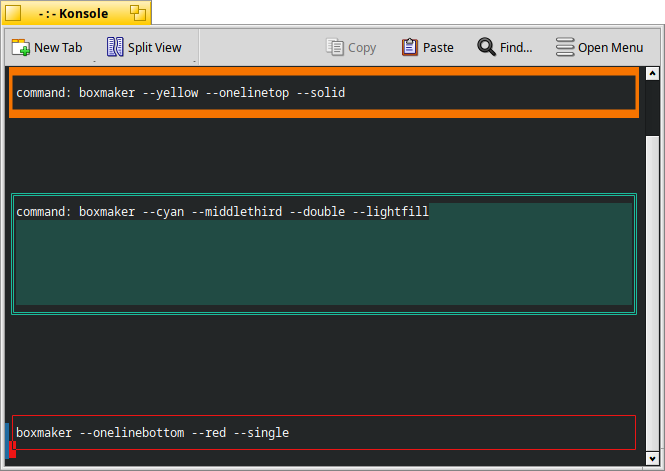
Demo shell script:
!
clear
boxmaker --yellow --onelinetop --solid
echo "command: boxmaker --yellow --onelinetop --solid"
boxmaker --cyan --middlethird --double --lightfill
echo "command: boxmaker --cyan --middlethird --double --lightfill"
boxmaker --onelinebottom --red --single
echo "boxmaker --onelinebottom --red --single"
read -n 1
Result:
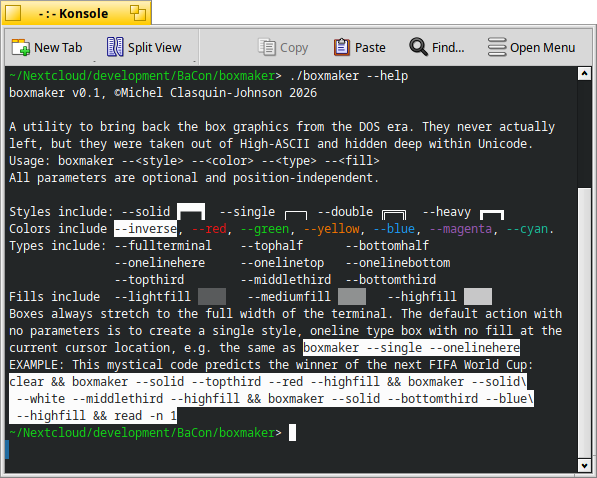
Of course, it can do more: Here's a look at the help:
This will be a Haiku-first project, but it should compile on any platform that has BaCON.